3 Ways to Cut Hiring TAT by 70% With AI in 2026
5
min read
December 22, 2025
Let’s be real for a second: hiring isn’t slow because recruiters lack skill, effort, or intent. Hiring is slow because everything around hiring is broken.
Chasing people. Drowning in resumes. Repeating the same question 100 times. Managing calendars that rarely align. All this, while praying that nothing falls through the cracks.
The good news? AI isn’t here to replace recruiters, it’s here to rescue them.
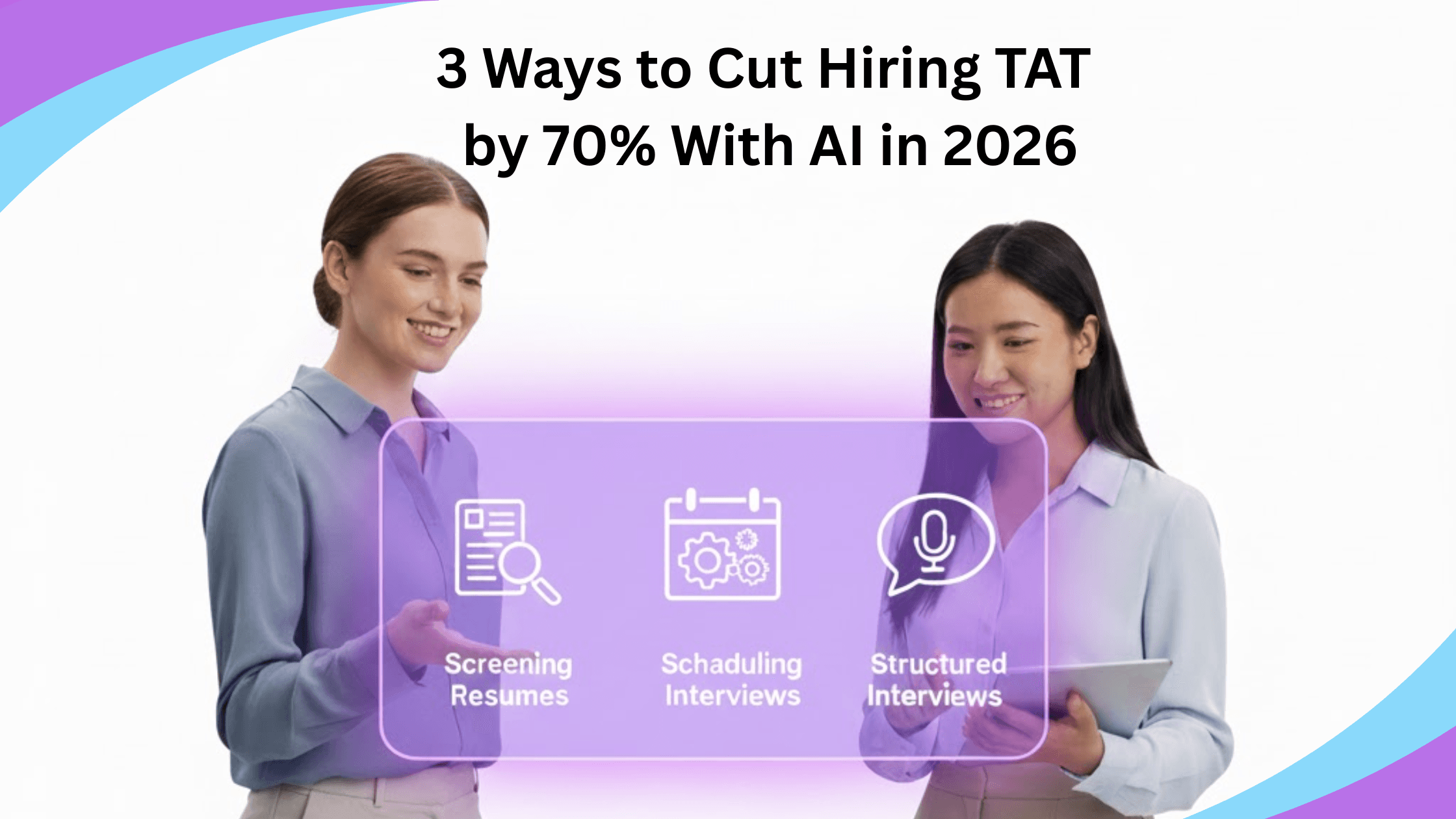
At BotFriday AI, we’ve seen teams cut hiring time by 70% or more simply by eliminating the three biggest productivity killers.
Let’s break them down.
1. Screening Resumes: The Silent Productivity Killer
Recruiters don’t spend hours screening resumes because they “love attention to detail.” They do it because 300 new applications hit their inbox every Monday.
And manual screening usually means:
Reading the same buzzwords over and over
Filtering irrelevant profiles that applied “just for fun”
Missing great talent because fatigue is real
And yes… mild eye pain + existential dread
The worst part? Two recruiters can review the same resume and walk away with completely different opinions. That’s not a skill problem, It’s a process problem.
At scale, resume screening becomes less about talent discovery and more about survival.
2. Scheduling Interviews
Recruiters: “Hey! What time works for you?”
Candidate: “Evening works.”
Hiring Manager: “Only mornings.”
Recruiter: cries internally
Research shows recruiters can spend up to 35% of their time just coordinating interviews. That’s time lost to emails, follow-ups, reschedules, and calendar mismatches.
This constant coordination slows pipelines, frustrates candidates, and pulls recruiters away from higher-impact work like assessment and hiring strategy.
3. Asking the Same First-Round Interview Question 100 Times
“What’s your experience with this tool?”
“Why are you interested in this role?”
“Walk me through your background.”
“What are your salary expectations?”
By the time you reach the 17th candidate, you’re basically running on muscle memory and caffeine.
It’s repetitive. It’s draining, and it steals hours every single day.
Repetition introduces risk:
Interviewer fatigue
Inconsistent follow-up questions
Variability in how candidates are evaluated
Less attention is given to later-stage, higher-impact conversations
When volume increases, quality often drops not because recruiters stop caring, but because humans aren’t built for endless repetition.
Exploring How AI Fixes the Broken Hiring Workflow
None of these challenges exists because recruiters aren’t capable. They exist because modern hiring volumes have outgrown manual processes. This is where AI-led automation steps in not to make decisions, but to remove friction.
Here’s how AI supports recruiters end-to-end:
1. Resume Screening at Scale
AI reviews large volumes of applications by evaluating profiles across multiple dimensions such as:
Skill relevance to the role
Depth and quality of experience
Career progression patterns
Potential red flags
This reduces manual screening effort, minimizes fatigue-driven errors, and brings consistency to shortlisting, especially when hundreds of applications arrive at once. Recruiters no longer need to scan every resume individually. They start with a structured, role-aligned shortlist and spend their time where human judgment matters most.
2. Interview Scheduling Without the Back-and-Forth
AI removes the constant coordination required to align candidates and interviewers. It manages availability matching, calendar syncing, confirmations, reminders, and rescheduling automatically.
Automation changes this dynamic by handling:
Availability coordination across candidates
Automatic booking and calendar syncing
Confirmation and reminder messages
Rescheduling without manual intervention
The result isn’t just operational efficiency, it’s a faster, smoother candidate experience and a pipeline that moves without constant human nudging. This not only saves hours of recruiter time but also creates a smoother, faster experience for candidates, without delays caused by manual follow-ups.
3. Structured First-Round Interviews
Early-stage candidate screening can be repetitive and time-consuming for recruiters. AI-powered structured interviews simplify this process by standardizing first-round conversations, ensuring every candidate is evaluated fairly and efficiently.
Key benefits:
Candidates are assessed using the same, role-specific question set
Responses are captured and analyzed consistently
Recruiters save time by avoiding repetitive screening tasks
By handling the initial round of interviews, AI allows recruiters to focus on deeper evaluation and meaningful interactions. This approach maintains human judgment where it matters most, while making the hiring process faster, more objective, and more efficient.
This doesn’t remove human judgment, it preserves it for higher-impact discussions, deeper assessments, and final decision-making.
When repetitive work is automated:
Recruiters spend more time on meaningful candidate interactions
Hiring managers get clearer, more consistent signals
Candidates experience a fairer, more structured process
Tools like BotFriday AI are designed to support exactly these areas like resume screening, interview scheduling, and structured first-round evaluations by removing mechanical effort while keeping human decision-making at the center.
The future of hiring isn’t about replacing recruiters. It’s about giving them the time, clarity, and consistency needed to hire better.
Ready to hire faster, better, and 70% smarter?
Check out BotFriday AI, your new favourite teammate who never sleeps, never forgets, and never ghosts a candidate. Book your demo now to see it in action.
Key Questions Hiring Teams Ask About AI in Recruitment
1. How do HR teams actually use AI in hiring today?
HR teams use AI to support high-volume, repetitive parts of the hiring process. This typically includes resume screening, interview scheduling, and early-stage candidate assessments. By automating these operational tasks, recruiters are able to spend more time on evaluation, relationship-building, and decision-making rather than on administrative work.
2. Are AI-driven interviews replacing human interviews?
No. AI-driven interviews are generally used for first-round screening, not final evaluation. They help standardize early conversations by asking role-specific questions and capturing responses consistently. Human recruiters and hiring managers still conduct deeper interviews, assess cultural fit, and make final hiring decisions.
3. How does AI improve resume screening without removing human judgment?
AI helps by analyzing resumes at scale and highlighting candidates who meet role-specific criteria. Instead of replacing judgment, it narrows the pool and brings consistency to shortlisting. Recruiters remain responsible for reviewing shortlisted profiles and making final decisions.
4. Can AI reduce bias in the hiring process?
AI can reduce process-driven bias caused by fatigue, inconsistency, or time pressure. By applying the same evaluation framework across candidates, AI introduces consistency. However, AI works best when paired with thoughtful human oversight and clearly defined hiring criteria.
5. What parts of hiring benefit most from automation?
The biggest gains come from automating tasks that are repetitive and time-consuming, such as resume screening, interview scheduling, follow-ups, and early assessments. These areas slow hiring down but don’t require deep human judgment, making them ideal for AI support.
6. Is AI only useful for high-volume hiring?
High-volume hiring sees the fastest impact, but AI is also valuable for niche and senior roles. Even with smaller pipelines, automation reduces delays, improves consistency, and frees recruiters to focus on deeper candidate evaluation.

Siddhi Pawar