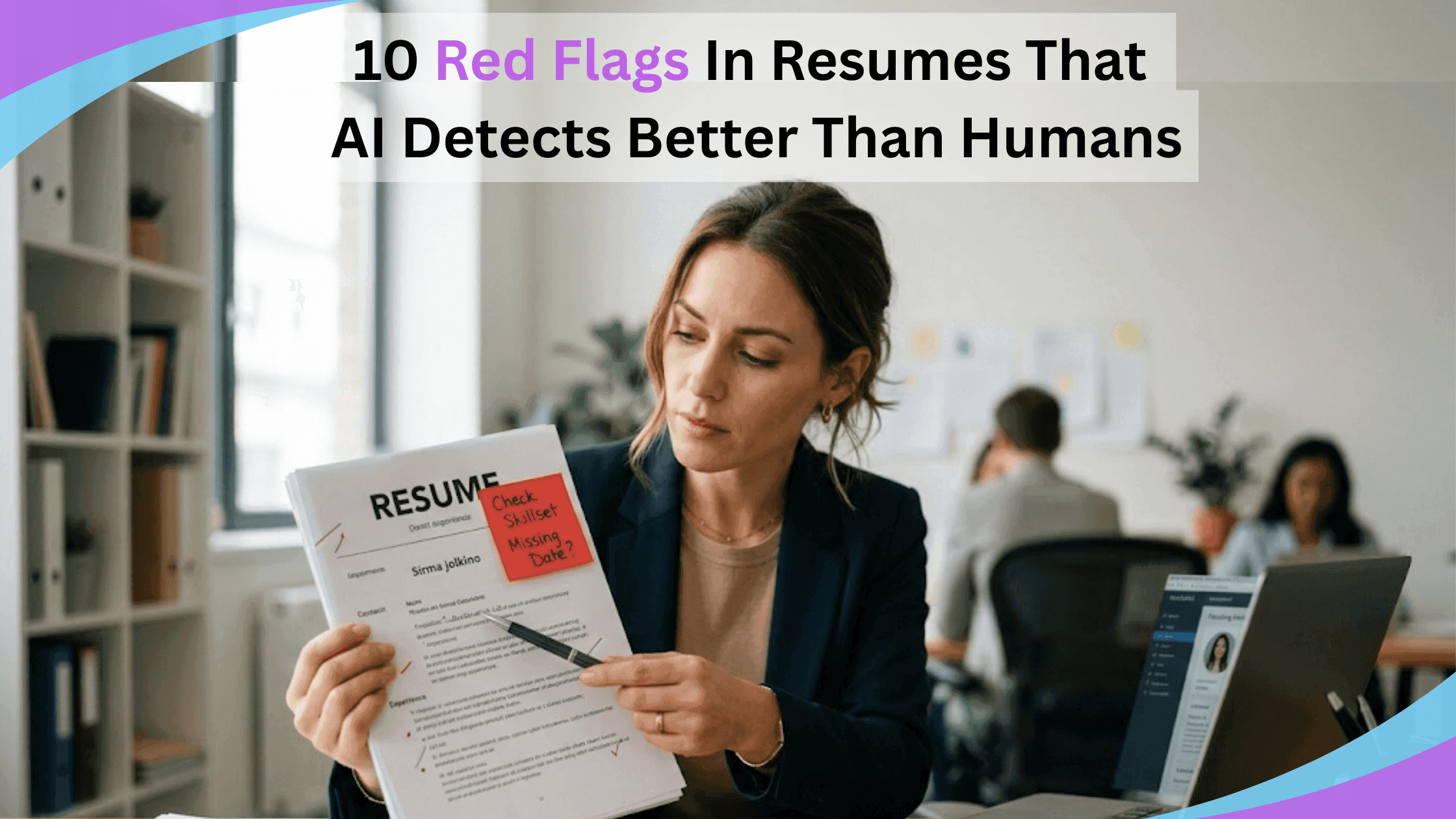
Hiring teams miss things - AI doesn’t.

When you’re reviewing 200+ résumés in a day, it’s impossible to catch every inconsistency, contradiction, or hidden signal. AI, on the other hand, reads résumés with forensic precision line by line, timeline by timeline, word by word.

And that’s where it consistently outperforms human reviewers.

Here are 10 résumé red flags that AI detects better, faster, and far more accurately than humans ever can.


1. Timeline gaps that don’t match stated experience

A candidate may write:

“5 years of experience”

Humans rarely calculate timelines manually.

What AI detects: mismatched date ranges, overlapping contracts, or total tenure that contradicts a stated experience claim.

Why it matters: someone claiming “5 years” may actually have 3.8 years of work when you add up dates.

Recruiter action: surface the mismatch as a screening question - ask for clarification on the first touch.


2. Job titles that grow unrealistically fast

Example:

2019 - Intern

2020 - Analyst

2021 - Senior Manager

2022 - Director

What AI detects: rapid title jumps (Intern → Manager → Director) without company size or scope to justify them.

Why it matters: sudden jumps often signal résumé inflation or misrepresented scope.

Recruiter action: verify via targeted screening questions about responsibilities and team size.


3. Responsibilities copied from ChatGPT or generic résumé templates

Phrases like:

  • “Leveraged cross-functional synergies…”

  • “Optimized dynamic workflows…”

  • “Demonstrated exceptional stakeholder engagement…”

Humans usually gloss over it

What AI detects: repeated sentence patterns, compares patterns across millions of resumes.

boilerplate verbs, and phrasing that mirrors résumé templates or large-scale AI output.

Why it matters: generic copy usually lacks concrete outcomes and suggests AI-generated fluff, generic template language, or overly polished jargon.

Recruiter action: request examples, project links, or a one-paragraph summary that proves ownership.


4. Overloaded skill lists with no depth indicators

A candidate claiming:

Python, Java, React, AWS, Terraform, Kubernetes, TensorFlow, Django, Node.js, Rust …all with “expert proficiency” is a red flag.

What AI detects: laundry lists of technologies without project references or role-based usage.

Why it matters: claiming many skills without evidence usually means shallow exposure, not expertise i.e. skill inflation.

Recruiter action: flag for portfolio review or short technical take-home assessment.


5. Inconsistent design, fonts, spacing, or formatting

Inconsistencies often indicate:

  • Copy-paste from multiple old résumés

  • Merged profiles

  • Editing by someone else

  • Hidden plagiarism

What AI detects: mixed fonts, inconsistent date formats, odd spacing, and sections pasted from multiple documents.

Why it matters: these artefacts often indicate stitched résumés, ghostwriting, or carelessness - all warrant verification.

Recruiter action: route to a quick human sanity check before an auto-reject.


6. Company names that don’t exist

Humans rarely verify employers. AI flags it. Instantly.

What AI detects: company names that return no credible web footprint, unclear company types, or unverifiable listings.

Why it matters: fake employers are one of the strongest indicators of fabricated experience.

Recruiter action: either verify through references or deprioritise until verification is possible.


7. Vague achievements with no numbers

Humans skim “Handled projects”, “Was responsible for multiple tasks”, “Improved processes. AI quantifies metrics, outcomes, scope and impact. If none exist, the AI labels the achievements as low-signal.

What AI detects: vague verbs like “managed”, “handled”, or “responsible for” without numbers, scope, or outcomes.

Why it matters: without measurable impact you can’t judge seniority or effectiveness.

Recruiter action: ask for metrics (revenue impact, headcount, % improvement) in the screening call.


8. Résumé written entirely in buzzwords

Phrase clusters like:

  • “Strategic thinker”

  • “Results-driven innovator”

  • “Dynamic leader with a passion for excellence”

These sound impressive but often mean nothing and AI flags it as low authenticity.

What AI detects: inflated language like “visionary”, “results-driven”, “strategic leader” - used repeatedly with no context.

Why it matters: buzzwords often replace substance and make it hard to assess actual capability.

Recruiter action: deprioritise buzzword-heavy résumés unless concrete examples follow.


9. Skills listed but never used in any project

A candidate claims “React + Node.js”

…but has:

  • No React projects

  • No JavaScript achievements

  • Only backend responsibilities

Human reviewers rarely cross-link every skill with job duties and project descriptions.

What AI detects: a skill listed in the header but not used in any role description, project, or achievement.

Why it matters: skills require context to be trusted; unsubstantiated skills are likely superficial.

Recruiter action: request sample work (code repo, portfolio, case summary) or a brief technical check.


10. Too many short stints (pattern of instability)

Humans may see:

  • 6 months at Company A

  • 8 months at Company B

  • 5 months at Company C

… and miss the pattern.

AI identifies:

  • Job hopping

  • Unexplained exits

  • Pattern-based instability

It then scores the résumé accordingly - not based on judgement, but on data.

What AI detects: repeated short tenures across roles and industries.

Why it matters: while not automatically disqualifying, unexplained patterns indicate risk and need context.

Recruiter action: route to human screening to understand reasons (contract work, caregiving, relocation, etc.).


The truth: AI isn’t biased. It’s consistent.

Humans reject candidates based on:

  • Mood

  • Fatigue

  • Recency bias

  • Assumptions

  • Pressure to close roles quickly

AI rejects based on rules, metrics, patterns, and evidence - nothing else.

AI-powered résumé screening brings:

  • Better quality shortlists

  • Fewer hiring mistakes

  • Faster evaluation

  • No emotional bias

  • No fatigue-driven errors

This is why more companies rely on AI resume checkers before humans even touch the funnel.


Final Thoughts

Most résumés look fine at first glance but fall apart on closer inspection.

AI gives every résumé:

  • A deeper check

  • A more consistent check

  • A more honest check

And it does it in milliseconds.

The outcome: Stronger pipelines, fewer bad hires, and a hiring process that finally scales.


FAQ

1. Do these red flags mean candidates are bad?
Not always. AI flags them for review - humans make the final decision.

2. Does AI reject candidates automatically?
No. AI helps shortlist and score résumés; final calls remain with hiring teams.

3. Is AI résumé screening biased?
Modern systems are trained to reduce bias by focusing on skills, outcomes, and signals.

4. Can candidates fix these red flags?
Absolutely - clarity, measurable impact, and clean formatting solve 80% of issues.

5. Is AI better than ATS?
ATS tracks résumés. AI understands them.


If you want an AI screening process that catches these red flags instantly:

Try BotFriday AI.

Our AI agents analyze résumés, score candidates, detect inconsistencies, and give your hiring team clean, high-quality shortlists - automatically.

Book a demo: https://www.botfriday.ai/demo
Talk to sales: connect@botfriday.ai
Explore Agent Lex: https://www.botfriday.ai/agent-lex

Let your team interview the best candidates - let AI filter out the rest.

Tanvi Vyas

Save Time, Cut Costs, Boost Efficiency With BotFriday

Let our AI agents take care of the manual work so your team can focus on making great hires. Ready to transform your recruitment process?

Save Time, Cut Costs, Boost Efficiency With BotFriday

Let our AI agents take care of the manual work so your team can focus on making great hires. Ready to transform your recruitment process?

Save Time, Cut Costs, Boost Efficiency With BotFriday

Let our AI agents take care of the manual work so your team can focus on making great hires. Ready to transform your recruitment process?