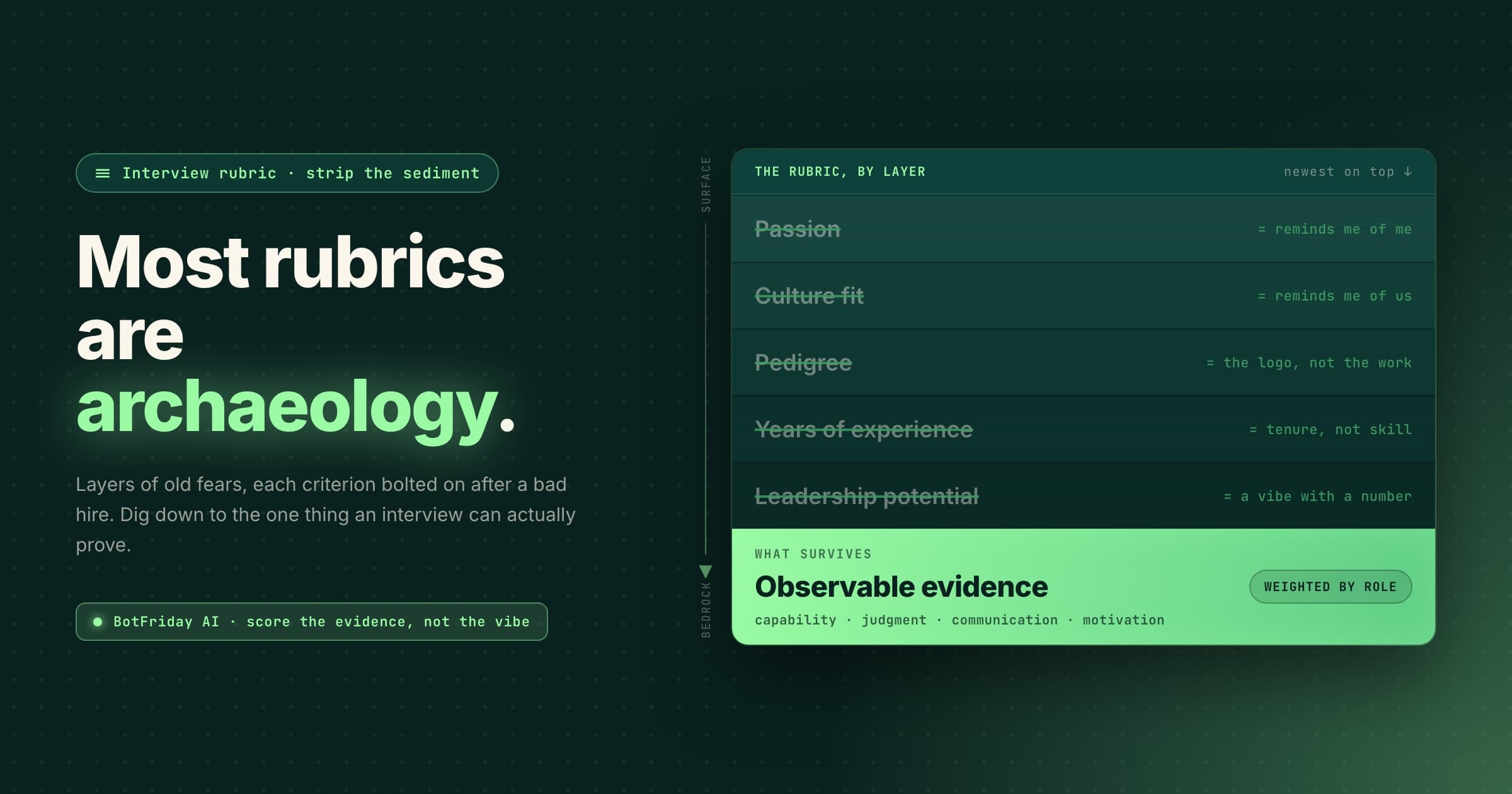
Most interview rubrics are archaeology. A good interview rubric for hiring should be a sharp tool; instead it ends up a record of every hiring mistake a company has ever made, with a new criterion bolted on after each one. Someone hired a brilliant engineer who couldn't work with the team, so "collaboration" got added. Someone hired a great culture fit who couldn't do the job, so "technical depth" got bumped up. After a few years, the rubric is a sediment of old fears: long, unweighted, and impossible to actually use under the pressure of a live interview.
At BotFriday, we spend our days on exactly this problem. We're the AI layer that runs the top of the hiring funnel, evaluating resumes, conducting structured screening conversations, and scoring candidates before a human ever picks up the phone. And here's what we learned early: none of that automation is worth anything if the rubric underneath it is broken. An AI that scores candidates against a vague rubric just produces vague scores faster. So we had to answer a question most hiring teams never get around to answering: If you were building the rubric from scratch, knowing what AI can and can't do, what would it actually look like?
This post is our answer. It's the rubric we'd build from a blank page in 2026, and it's close to how BotFriday actually scores candidates today. Whether you're hand-running interviews or evaluating candidates at scale, the thinking is the same. The rubric is where evaluation either becomes rigorous or stays a guessing game.
The first principle: a rubric measures evidence, not impressions
The single biggest failure of most rubrics is that they ask interviewers to rate things they can't actually observe in an interview. "Leadership potential." "Cultural fit." "Passion." These aren't criteria; they're vibes with a number next to them. An interviewer scoring "passion" is really scoring how much the candidate reminded them of themselves.
A rubric that works measures evidence the interview can actually produce. The question isn't "is this candidate passionate?" it's "what did the candidate do or say that constitutes evidence about how they'd perform in this role?" Everything in a good rubric has to be tied to something observable: a decision the candidate described, a problem they worked through live, a tradeoff they articulated, a question they asked.
If a criterion can't be tied to observable evidence, it doesn't belong in the rubric. It belongs in the bin with the other biases you're trying to design out. This is also the first thing that has to be true for evaluation to be automatable at all. An AI can score evidence, but it can't score a vibe. When we built BotFriday's scoring, "is this observable?" was the first filter every criterion had to pass.
The four dimensions of a hiring rubric
Strip away the sediment and almost every role-relevant signal falls into one of four dimensions. The weighting changes by role, but the dimensions are stable.
- Capability: Can they actually do the work? The core competency the role requires, evaluated against real tasks, not credentials. For an engineer, can they reason through a system design problem. For a PM, can they structure an ambiguous problem and prioritize. For a salesperson, can they run a discovery conversation. This is the dimension most rubrics think they measure but actually measure poorly, because they substitute proxies (years of experience, prestige of past employers) for direct evidence of capability.
- Judgment: Do they make good decisions under uncertainty? Capability is whether they can execute. Judgment is whether they execute on the right things. This is the dimension that separates a senior hire from a junior one, and it's almost entirely invisible to keyword filters and resume scans. You surface it by asking about real decisions the candidate has made, "tell me about a time you had to choose between two bad options," and listening for whether they understood the tradeoffs, not just the outcome.
- Communication: Can they make their thinking legible to others? Not "are they articulate" in a charismatic sense. That's a bias trap. Communication here means: can they explain a complex decision clearly, can they tailor an explanation to the listener, can they disagree without being combative. This dimension matters more the more cross-functional the role. It's also the one most contaminated by surface charm, so a good rubric explicitly separates clarity of thinking from smoothness of delivery.
- Motivation: Do they want this specific role, for reasons that will last? The weakest dimension to over-index on, but a real one. Not "are they excited," since anyone can perform excitement in an interview, but "do their stated reasons for wanting this role align with what the role actually is?" A candidate who wants the role for reasons the role can't deliver will leave in eight months, no matter how capable they are.
That's the whole framework. Four dimensions, each tied to observable evidence. Everything most rubrics measure is either a subset of these or a bias dressed up as a criterion.
Weighting: the part everyone skips
Here's where most rubrics fail even when the criteria are good: they treat every dimension as equally important and let the interviewer average them in their head. That's how you end up hiring the candidate who was a 7 on everything over the candidate who was a 9 on the two things that actually matter for the role and a 5 on the two that don't.
A rubric without weights isn't a rubric. It's a checklist.
The weighting is where role-specific judgment lives. For a founding hire at an early-stage startup, capability and judgment might be 70% of the score combined, because there's no team to compensate for weakness and no process to lean on. For a customer-facing role on a large team, communication might carry far more weight. The dimensions stay the same; the weights are how you encode what this role actually needs.
The discipline this forces is valuable on its own. Sitting down before the interview and deciding "for this role, judgment is worth twice what motivation is worth" makes you articulate what you're actually hiring for, which, as with job descriptions, is most of the battle.
A worked example: a software engineer
Abstract frameworks are easy to nod along to and hard to use. So here's the rubric, instantiated for a mid-level software engineer at a growth-stage company.
Capability (40%): Can they actually write and reason about code? Not "do they know the syntax." Can they take a loosely specified problem, reason about the right data structures and tradeoffs, and produce something correct and maintainable? Evidence: how they work through a realistic problem live, including how they handle the parts they don't immediately know, and how they describe the technical decisions in systems they've actually built. The signal isn't whether they reach the textbook-optimal answer; it's how they reason when the answer isn't obvious.
Judgment (30%): Do they make good engineering decisions under real constraints? This is what separates a senior engineer from a fast junior one. Do they know when to reach for the simple solution over the clever one? Can they explain why they chose an architecture, what they traded away, and what broke later? Evidence: their reasoning on past technical decisions, especially the ones that aged badly. An engineer who can only describe what they built, not why, hasn't developed judgment yet.
Communication (20%): Can they make their technical thinking legible to others? Can they explain a tricky bug to a teammate, justify a design in code review without getting defensive, and translate a constraint for a non-technical stakeholder? Evidence: how clearly they explain a past technical decision, and whether they can adjust the explanation when you play the role of someone less technical. Note this is separate from how smoothly they talk. A quiet engineer who explains clearly outscores a charismatic one who hand-waves.
Motivation (10%): Do they want this engineering role, this stack, this problem space, this stage, or just an engineering job somewhere? Evidence: the specificity of the questions they ask about the codebase, the team, and the technical challenges.
Notice that capability and judgment together carry 70% because for an engineer, the failure modes that hurt most are "couldn't actually do the work" and "made decisions that cost the team for years." Communication matters but is third. Motivation is a tiebreaker, not a driver. A team hiring a staff engineer would shift weight toward judgment; a team hiring a junior would weight raw capability and learning speed higher. The framework is fixed; the weights carry the role and the level.
This is exactly the work BotFriday does before it ever evaluates a candidate: a rubric like this gets built per role, the weights set to match the level and the team so the screening conversation and the score that comes out of it are calibrated to this job, not a generic template. But there's a step between "four weighted dimensions" and "a candidate gets a score," and it's worth being precise about it because it's where most of the rigor actually lives.
From dimensions to questions: how the rubric actually runs
Here's the part most rubric discussions skip, and it's the part that matters most once you're evaluating at scale.
You don't score a candidate by asking them to "demonstrate judgment" and giving them a 7. Dimensions aren't questions. They're what questions are for. The actual rubric is a set of concrete, role-calibrated questions, each one chosen because it produces evidence about one or more of the four dimensions. Capability and judgment for a software engineer get probed by questions like "how would you find the middle element of a linked list in one pass?" or "should passwords be stored in plain text? Explain your answer." The dimension is the target; the question is the instrument.
And each question is scored on its own, against three things:
Difficulty. Not every question is worth the same. A hard question that a candidate handles well is stronger evidence than an easy one. Weighting by difficulty is how the rubric avoids rewarding someone for clearing a low bar. Getting the easy database-indexing question right counts, but it counts for less than reasoning correctly through a hard cache-design question.
Evidence, with written reasoning. This is the non-negotiable one. Every score comes with a justification a human can read and overrule, not just "8/10" but why: what the candidate got right, where the reasoning was sound, where it broke down. A candidate who correctly says passwords must be hashed but then conflates encryption with hashing and omits salting doesn't get a binary pass/fail. They get a partial score with the specific conceptual gap named. That written reasoning is what turns a number into something a hiring manager can actually act on, or disagree with.
A strict standard for credit. A good rubric doesn't hand out points for confident-sounding answers that are actually wrong. If there's no acceptable answer on record for a question, the safe default is to award nothing rather than reward fluency, because rewarding fluency over correctness is exactly how interviews get gamed. Better a hard zero that a human can review than a soft point that launders a wrong answer into a passing score.
The four dimensions are how you think about what you're measuring. The scored questions are how you actually measure it. A candidate's overall score is the sum of their question scores, rolled up. And because each question maps back to a dimension and carries a difficulty weight, the final number is both a single comparable figure and fully decomposable into "here's exactly where it came from." That decomposability is the whole point. A score you can't explain is a score you can't defend.
This is how BotFriday's evaluation actually works: role-calibrated questions, each scored on evidence with written reasoning, weighted by difficulty, rolled up into a score that traces all the way back to specific answers. The four dimensions in this post are the conceptual layer. The scored questions are the machine underneath it.
What this rubric deliberately leaves out
Three things a 2026 rubric should consciously not include, because each one is a well-documented bias generator:
Years of experience as a criterion. Experience is an input that may produce capability and judgment, but it's those outputs you're scoring, not the years themselves. A rubric that gives points for tenure is double-counting at best and filtering out fast learners at worst.
Pedigree. The prestige of past employers or universities is often an unreliable proxy for how someone will perform on the job and can introduce bias into hiring decisions. If a candidate's time at a well-known company produced real capability, that capability will show up in the capability score. The logo shouldn't get its own points.
"Culture fit" as a freestanding criterion. The intent behind it is real: will this person work well here? But as an unweighted vibe, it's the single most common vector for bias in hiring. If there are specific behavioral norms the role requires, name them and fold them into communication or judgment as observable evidence. "Fit" on its own just means "reminds me of us."
Why this matters more in 2026 than it did before
There's a reason to rebuild the rubric now specifically, and it's not just hygiene.
When parts of the early funnel are AI-conducted (resume evaluation, structured screening, scored responses), the rubric stops being a piece of paper an interviewer half-remembers and becomes the actual specification the system runs on. An AI evaluating a screening conversation can only be as good as the rubric it's given. A vague rubric produces vague scores, automated. A rubric built on observable evidence, weighted deliberately by role, produces structured, comparable, defensible signal at scale.
This is the part we care about most at BotFriday, because it's the difference between "AI that rates candidates" and "AI that evaluates candidates against a defensible standard." The rubric isn't a formality that precedes the evaluation. The rubric is the evaluation. Get it right and everything downstream inherits the rigor. Get it wrong and you've just automated your old biases faster.
The test for any interview rubric
Before you adopt a rubric, this one or any other, run it against one question: if two interviewers used this rubric on the same candidate, would they arrive at similar scores?
If yes, the rubric measures something real. If not, the scores would diverge based on who was in the room. Then the rubric is measuring the interviewer, not the candidate. That's the bar. A rubric exists to make evaluation consistent across people and across time. Everything in this post is in service of that one outcome: scores that reflect the candidate, not the room.
BotFriday scores every candidate against a role-specific rubric: concrete questions targeting capability, judgment, communication, and motivation, each scored on evidence with written reasoning and weighted by difficulty, so the signal your team gets is structured, comparable, and traceable to specific answers, not a stack of gut calls. If you want to see what evaluation looks like when the rubric does the work, book a demo.