Why ATS Systems Are Shortlisting the Wrong Candidates: The Impact of AI-Generated Résumés
6
min read
March 27, 2026
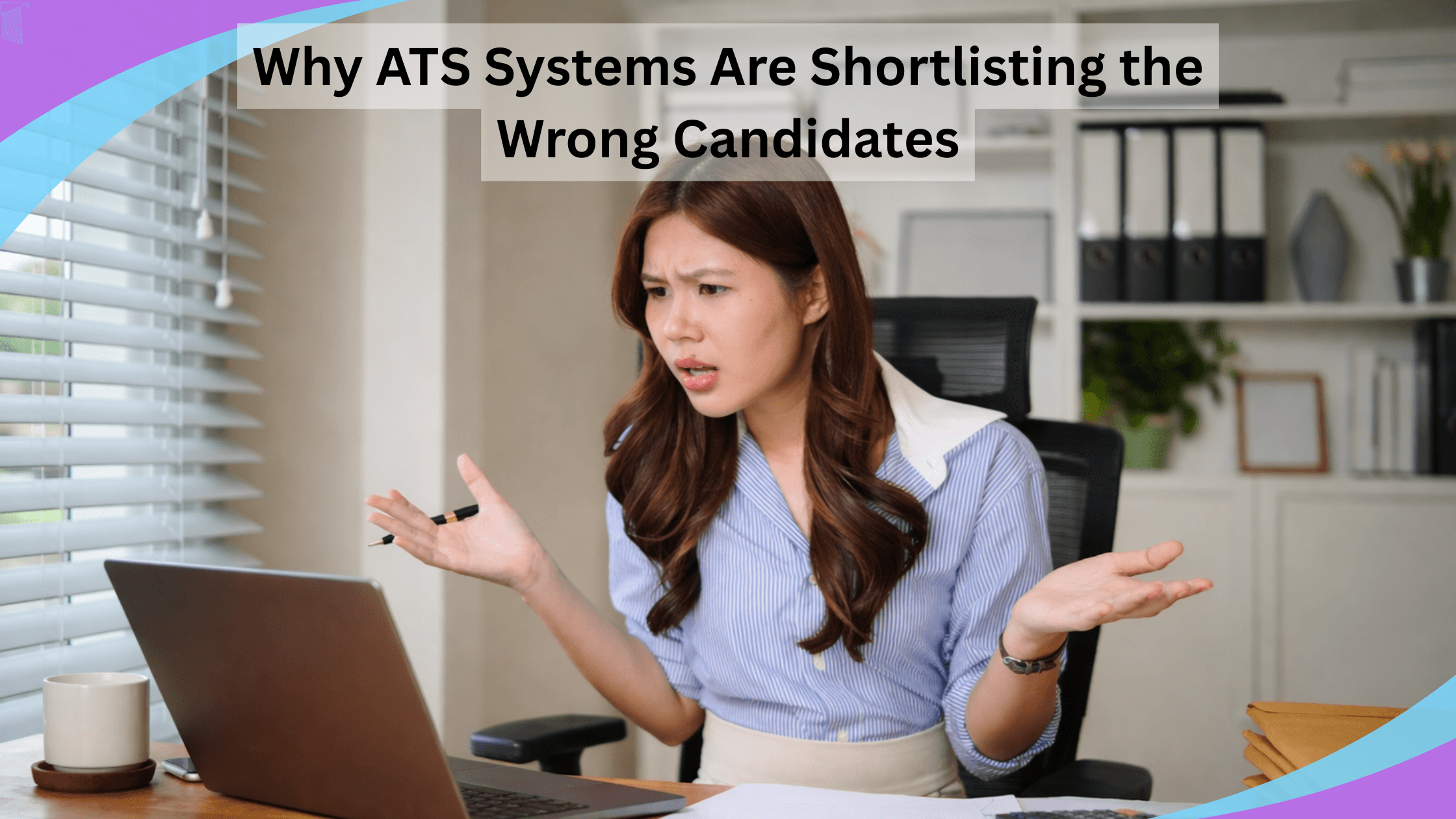
Your team just opened a role and within 48 hours, you have 300 applications. Your ATS does its job. It scans, ranks, and surfaces the top 20 candidates.
On paper, they look perfect.
Every required skill is listed
Experience aligns exactly with the job description
Projects sound relevant
You shortlist them and start interviewing. Within the first few conversations, a pattern emerges. Candidates struggle to explain what they’ve written. They can’t go deep into projects. They give surface-level answers.
Now your team is stuck:
You’ve already spent hours screening
Your pipeline looks “full”
But quality is low
This isn’t a coincidence. This is the result of a fundamental shift in hiring.
Candidates are using AI to generate résumés that perfectly match your job description and your ATS is rewarding them for it.
The Reality of Modern Screening
Traditional hiring workflows assume one thing - if a résumé matches the job description, the candidate is likely a good fit. That assumption no longer holds. Today, candidates don’t need to be a good match. They just need to look like one. And AI makes that extremely easy.
The Core Limitation: ATS Understands Words, Not Meaning
To understand why ATS systems fall for this every time, you need to understand how most ATS systems work. At their core, they are designed to do three things: parse résumés, match keywords and rank candidates. This worked well in a pre-AI world because writing a good résumé took effort, keyword alignment required real experience and candidates couldn’t easily tailor applications at scale
But AI has broken this model.
An ATS does not understand or check:
depth of experience
complexity of work
ownership of projects
authenticity of claims
It only understands keyword presence of keywords, frequency of keywords and placement of keywords. So when a résumé contains the exact tools from the JD, similar phrasing and aligned responsibilities, it gets ranked higher. Even if the underlying experience is weak.
Why AI-Generated Résumés Beat ATS Systems
AI is excellent at one thing:
Matching patterns perfectly.
Candidates today are using AI tools to generate résumés that perfectly match your job description. They paste the JD, AI rewrites their experience, the résumé looks like an ideal fit.
And your ATS? It ranks them at the top. Even when the experience is superficial. This is why AI-generated résumés perform so well.
When candidates input your job description, AI:
Injects all relevant keywords
Mirrors responsibilities as experience
Creates balanced skill sections
Aligns everything to your JD
To an ATS, this looks like a perfect match.
To a human, it often lacks depth.
7 Ways ATS Screening Breaks Down by AI-Generated Résumés (In Practice)
Let’s look at what actually happens during screening.
1. Keyword Matching Replaces Skill Validation
A candidate mentions “Python” 8-10 times. The ATS boosts their ranking.
But it cannot answer:
Did they build anything meaningful in Python?
Was it production-level or basic scripts?
Did they solve real problems?
The system assumes presence = proficiency.
2. No Context Around Experience
Consider two candidates:
Candidate A: “Worked with React”
Candidate B: “Built a production React application used by 50,000 users”
To an ATS, both are nearly equal. To a hiring manager, they are completely different.
3. No Understanding of Depth or Ownership
ATS cannot distinguish between:
contributing to a project
owning and delivering a project
This leads to inflated profiles being ranked highly.
4. No Timeline Intelligence
ATS does not evaluate:
how long a skill was used
whether it’s recent
whether roles overlap logically
So:
outdated skills still rank
short-term exposure looks like expertise
5. No Detection of AI-Generated Patterns
AI-generated résumés often have clear signals:
overly structured language
repeated sentence formats
generic achievements
Humans can sometimes sense this.
ATS cannot.
6. No Signal Weighting
All keywords are treated equally.
Which means:
critical skills
nice-to-have skills
minor exposure
…all contribute similarly to ranking. This distorts candidate quality.
7. Easily Gameable by Design
Because ATS relies on predictable logic, it is easy to manipulate.
Candidates can:
copy your job description
inject keywords
restructure experience using AI
And immediately improve their ranking.
The Result: You’re Ranking the Best Résumé, Not the Best Candidate
This leads to:
wasted interviews
poor hiring decisions
longer time-to-hire
lower quality hires
The system rewards optimization, not capability.
“If you build the right team, your company is successful. If you don’t, you’re just going to deal with a lot of issues.”
Kaushik Chandreshekhar, VP Engineering, Interface.ai (Ctrl+H Podcast)
The Hidden Cost No One Talks About
This problem doesn’t just affect screening. It impacts your entire hiring pipeline.
Time Cost - Recruiters spend hours reviewing candidates who shouldn’t have been shortlisted.
Interview Cost - Hiring managers waste time evaluating low-signal candidates.
Opportunity Cost - Strong candidates get buried because they didn’t optimize their résumé.
Quality Cost - Hiring decisions become less reliable.
What Modern AI Resume Screening Does Differently
AI-native systems go beyond keyword matching.
They evaluate:
Context - How skills are actually used in projects
Depth - Level of ownership and complexity
Consistency - Alignment across timeline, roles, and achievements
Signal Quality - Detection of vague, inflated, or generic content
Pattern Recognition - Identifying AI-generated structures and repetition
This shifts hiring from:
Keyword Matching to Capability Detection
The Winning Hiring Stack: ATS + AI + Human Judgment
The best teams don’t replace ATS. They upgrade it.
Use ATS for:
pipeline management
tracking candidates
workflow automation
Use AI for:
resume screening
signal detection
ranking based on real quality
Use humans for:
final evaluation
cultural fit
nuanced judgement
FAQ
Q: Should companies stop using ATS?
A: No. ATS is essential for managing hiring workflows. It just shouldn’t be your screening engine.
Q: Can ATS systems be improved?
A: Some modern ATS platforms are evolving, but most still rely heavily on keyword matching.
Q: Are AI-generated résumés always bad?
A: No. The issue isn’t AI usage, it’s when résumés overstate or misrepresent experience.
Q: What’s the biggest hiring risk today?
A: Confusing a well-optimized résumé with a qualified candidate.
Q: What’s the fastest fix?
A: Add an AI screening layer that evaluates depth, not just keywords.
Final Thoughts
Hiring has fundamentally changed. Candidates now optimize their résumés using AI. If your system still relies on keyword matching, you’re not evaluating candidates, you’re evaluating how well they use AI.
The shift is clear:
From keyword matching to real capability detection.
Stop ranking résumés. Start evaluating candidates.
BotFriday AI adds an AI layer on top of your ATS to detect real candidate quality and eliminate résumé manipulation.
Book a demo: https://www.botfriday.ai/demo
Talk to sales: connect@botfriday.ai
Learn about Agent Lex: https://www.botfriday.ai/agent-lex

Tanvi Vyas